Understanding the Fort Ord Reuse Authority (FORA) Impact on Marina and Seaside
Real Estate, Fort Ord redevelopment real estate impact, Marina CA, Seaside CA
Understanding the Fort Ord Reuse Authority (FORA) Impact on Marina and Seaside
For long-term buyers and investors, the former Fort Ord is one of California’s most consequential—and misunderstood—real estate stories. The scale of land, infrastructure investment, and institutional growth has already reshaped Marina and Seaside, with more change coming over the next 10–20 years. Understanding the true Fort Ord redevelopment real estate impact is essential if you want to position capital intelligently in these emerging submarkets.
1. FORA in Context: From Base Closure to Local Control
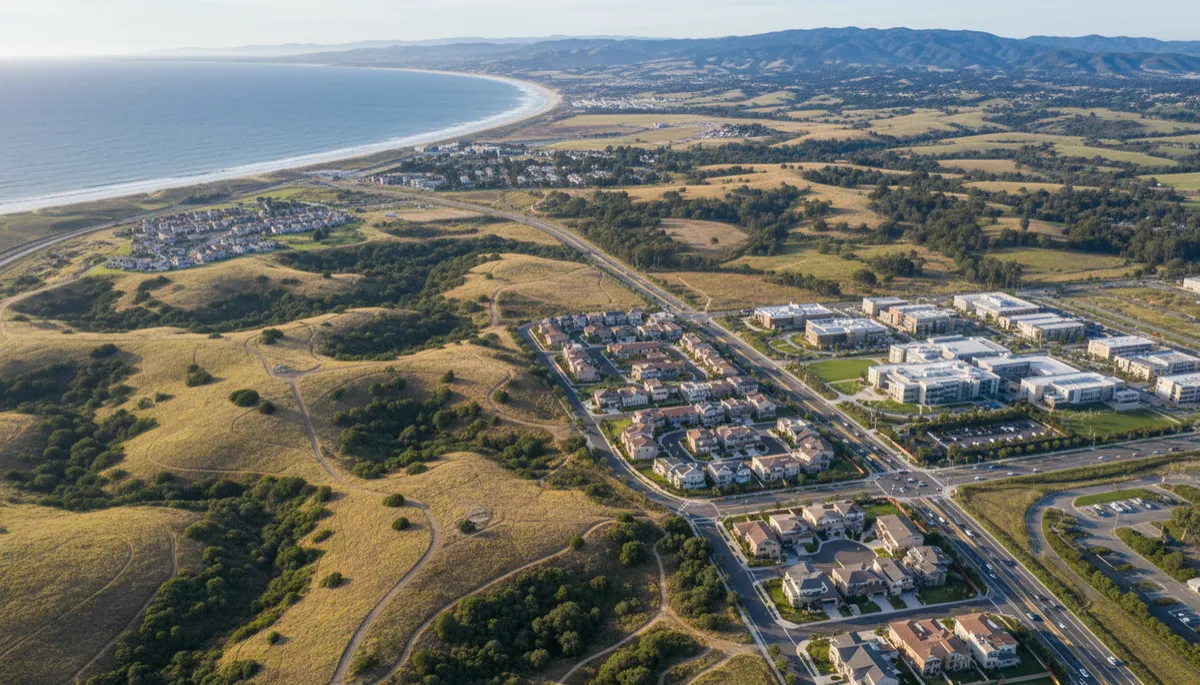
When the U.S. Army closed Fort Ord in 1994, it left behind more than 45,000 acres of coastal California land—plus a complex mix of environmental, economic, and planning challenges. The State of California created the Fort Ord Reuse Authority (FORA) that same year to coordinate the transition from active base to civilian use across multiple jurisdictions, including Marina, Seaside, Monterey County, and others.
FORA’s mandate was broad: build a regional reuse plan, secure funding, oversee major infrastructure, and knit together local general plans with federal and state requirements. Over roughly 25 years, FORA helped deliver:
- The land transfer and entitlement framework that enabled California State University Monterey Bay (CSUMB) to grow on former base property.
- Regional infrastructure—roads, utilities, and habitat mitigation—that individual cities could not have financed alone.
- A coordinated base reuse plan that envisioned thousands of housing units, new job centers, and permanent open space.
FORA formally dissolved in June 2020. Since then, governance has shifted to a network of successor agencies—primarily the individual cities (Marina, Seaside, Monterey, Del Rey Oaks), Monterey County, and the Fort Ord Reuse Authority Successor Agency that manages remaining financial and administrative obligations. In practical terms, this means entitlement decisions, zoning refinements, and many infrastructure choices now sit directly with local jurisdictions, while the Army continues to oversee major environmental cleanup responsibilities.
2. What Has Already Been Built on Former Fort Ord Land
Despite a slower-than-hoped build-out, the physical transformation of Fort Ord is substantial—and highly relevant to investors evaluating Marina CA real estate and Seaside CA real estate today.
CSUMB: An Institutional Anchor Driving Durable Demand
CSUMB opened in 1994 on converted Army facilities and has since evolved into a modern campus with approximately 7,000 enrolled students today and a long-range plan to grow further. Its current master plan looks toward 2035 and contemplates up to 12,700 full-time equivalent students, nearly 1,800 faculty and staff, and millions of additional square feet of academic, housing, and support space.
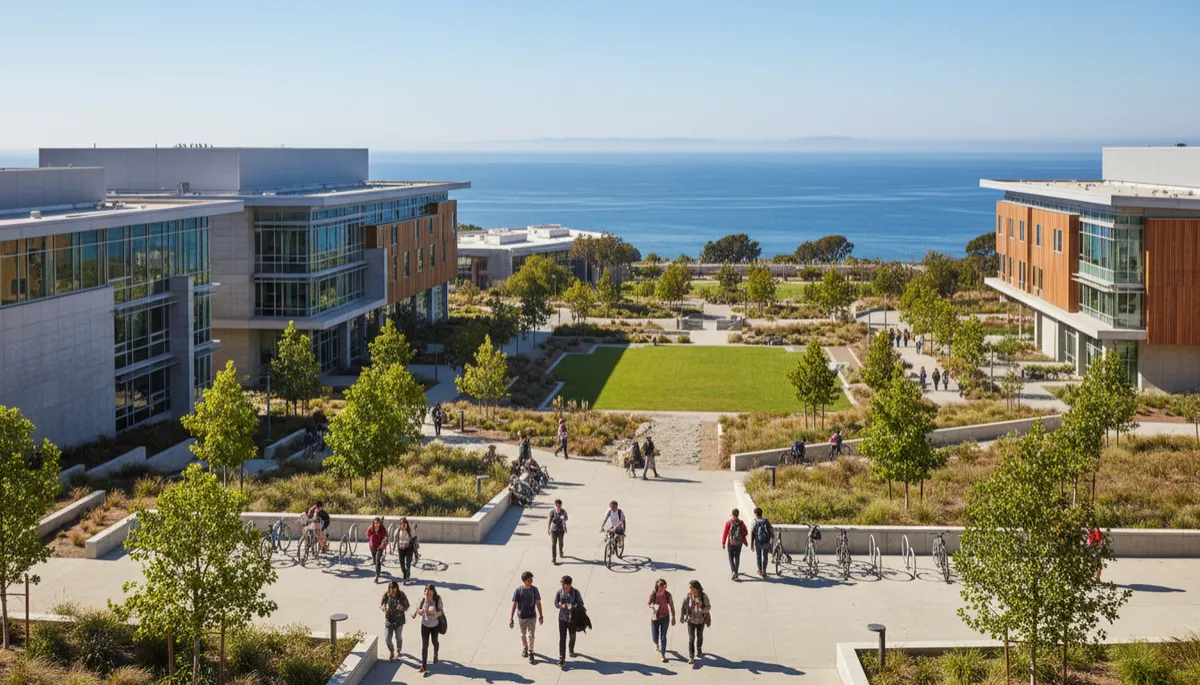
CSUMB’s continued expansion anchors long-term rental and housing demand in Marina and Seaside.
East Garrison and Other Residential Nodes
On the eastern side of Marina, East Garrison has emerged as a flagship master-planned community. Built on former military housing and support areas, it blends single-family homes, townhomes, and neighborhood parks, with a planned historic arts district repurposing 23 World War II–era buildings into creative and cultural uses. This is a textbook example of FORA’s vision—leveraging historic fabric, new housing, and public investment to create an entirely new neighborhood identity.
Within Marina more broadly, new construction clusters near Sea Haven, The Dunes, and the Imjin Parkway corridor have added hundreds of for-sale and rental units. For a closer look at build costs and margins in this submarket, see What New Construction Actually Costs in Marina in 2026.
Trails, Open Space, and the Monterey Bay Sanctuary Scenic Trail
One of FORA’s most enduring legacies is environmental. Approximately 28,000 acres of former Fort Ord land are now preserved as open space, much of it within Fort Ord National Monument. Layered onto that is a growing network of multi-use trails, including segments of the Monterey Bay Sanctuary Scenic Trail Network, which will eventually connect communities along the bay with a continuous coastal trail experience.
For investors, this matters. Permanent open space and regional trail systems behave like long-lived amenities—supporting price resilience, enhancing lifestyle appeal, and differentiating Marina and Seaside from more built-out coastal submarkets with limited room to add comparable recreational assets.
3. What Is Still Coming: Housing, Mixed-Use, and Economic Nodes
The Fort Ord Base Reuse Plan envisioned roughly 14,000 housing units region-wide across the former base footprint. Market updates suggest that, at current absorption rates, full build-out could extend another 20–30 years—well into the 2040s. For patient capital, that long runway is not a bug; it is a feature, creating multiple entry points across market cycles.
Remaining Marina Parcels
In Marina, remaining Fort Ord parcels include additional phases of master-planned communities, infill near the Imjin corridor, and future residential and mixed-use sites along Reservation Road. The Dunes at Monterey Bay has already proven the retail and lifestyle potential of this area; as additional rooftops come online, retail and services tend to follow, reinforcing the investment thesis. For a strategic overview of demand drivers in this submarket, see The Rise of Marina, CA: Why Investors and First-Time Buyers Are Flocking Here.
Seaside’s Campus Town, Main Gate, and Resort-Adjacency
Seaside controls some of the most strategically located Fort Ord parcels, particularly around the CSUMB edge and the Bayonet & Black Horse golf courses. The Campus Town Specific Plan envisions nearly 1,500 housing units, hospitality, retail, and flex space—essentially a new urban village connecting CSUMB to Seaside’s existing neighborhoods. Nearby, the Main Gate site is moving forward with a master developer to deliver a hotel, a new county courthouse, and additional mixed-use space.
Layered onto this is the long-discussed Seaside resort project at Bayonet & Black Horse—on the former Army golf course site. While timelines have stretched, the underlying concept remains powerful: high-end hospitality and resort residential product overlooking championship golf and the bay. For a deeper dive into how proximity to these courses translates into value, see Bayonet & Black Horse: The Real Estate Value of Living Near Championship Golf.
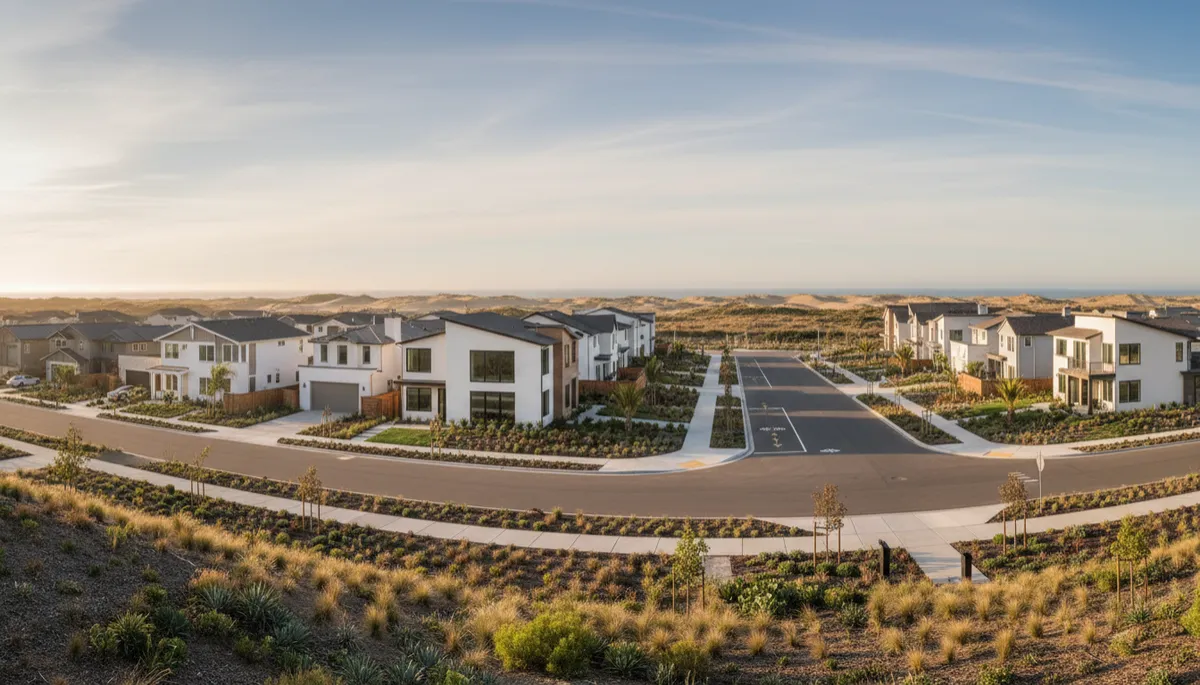
New Marina neighborhoods on former Fort Ord land are redefining sub-$1M coastal living.
4. The Contamination Reality: Real but Manageable for Informed Buyers
Any honest discussion of the Fort Ord redevelopment real estate impact must address legacy military contamination. Decades of training left unexploded ordnance (UXO), munitions fragments, and chemical residues in soils and groundwater. Fort Ord is a federal Superfund site, and the Army, EPA, and state agencies have been engaged in cleanup for more than 30 years.
The good news for investors is that the EPA reports cleanup goals for current and reasonably anticipated land uses have been achieved in developed areas, and groundwater migration is under control. Parcels that have completed remediation are issued a “no further action” (NFA) or equivalent designation—these are the areas where residential and commercial projects are being built today. Properties in these cleared zones do not carry elevated health risk compared with conventional properties in the region, assuming adherence to ongoing land-use controls where applicable.
In Marina, the Imjin corridor near CSUMB—where you see contemporary housing, student-serving rentals, and neighborhood retail—has largely been cleared and is functioning as a normal urban environment. By contrast, portions of the more inland Reservation Road corridor remain under active remediation or subject to specific restrictions, and some interior training ranges are still fenced off for UXO work and habitat management. The Army retains cleanup responsibility for these areas, and PFAS investigations are ongoing at a handful of sites, with results expected later this decade.
5. How FORA Has Reshaped Marina’s Investment Story
Marina has emerged as one of the clearest beneficiaries of Fort Ord reuse. The combination of CSUMB-adjacent housing, East Garrison’s master planning, and coastal proximity has repositioned Marina from a quiet, overlooked town into a sub-$1M coastal market with meaningful upside. For a broader market narrative, see Sub-$1M Coastal Homes in Monterey County: Why Marina Is Where Buyers Are Winning.
CSUMB as a Demand Engine
With roughly 7,000 students—and growth projected over the next decade—CSUMB generates consistent rental demand from students, faculty, and staff. Investors who own well-located single-family homes, townhomes, or small multifamily units near campus benefit from:
- Predictable turnover but resilient occupancy, even during broader market softening.
- A diversified tenant base—undergraduates, graduate students, staff, and faculty—reducing reliance on any single demand segment.
Retail, Services, and Price Trajectory
As East Garrison and other Fort Ord neighborhoods have filled in, Marina has seen a parallel rise in everyday amenities—restaurants, grocery options, fitness, and personal services—particularly along the Imjin corridor and at The Dunes. This amenity build-out is typical of successful base conversions and tends to support both rent growth and end-user appeal over time.
Price-wise, Marina has posted steady appreciation from its post-2008 lows yet still trades at a discount to Carmel, Pacific Grove, and even parts of Monterey. For long-term buyers, that spread is the opportunity: you are buying into a coastal city whose infrastructure, housing stock, and institutional anchors are still maturing. For an investor-oriented overview of this trajectory, review The Rise of Marina, CA: Why Investors and First-Time Buyers Are Flocking Here.
6. Seaside’s Fort Ord Advantage: From Entry-Level to Resort-Adjacent
Seaside occupies a different but equally compelling position in the Fort Ord story. It is the least-expensive entry point on the Monterey Peninsula proper, yet it controls some of the most strategic redevelopment sites near CSUMB and Bayonet & Black Horse. This duality—entry-level pricing plus high-end adjacency—is attracting a new wave of investors. For current velocity and pricing behavior, see Seaside Real Estate: The Fastest-Moving Market on the Peninsula.
Resort and Golf Course Proximity
Bayonet & Black Horse already function as championship-level public courses with sweeping bay views. The planned resort project—though delayed—would add hospitality, event, and potentially branded residential components. When resorts finally deliver, surrounding residential neighborhoods typically experience a step-change in perception and pricing, as seen in other golf-adjacent markets along the California coast.
Urban Corridors: Fremont Boulevard and Broadway Avenue
Within the city’s existing fabric, Seaside’s Fremont Boulevard and Broadway Avenue corridors are gradually shifting toward more mixed-use, pedestrian-friendly patterns. As Campus Town and Main Gate come online, these corridors are likely to see increased demand for small-scale infill, adaptive reuse, and higher-density residential over retail—formats that have driven strong returns in comparable college-adjacent markets nationwide. For a strategic perspective on why Seaside is drawing sophisticated capital, see Why Seaside Is the Next Big Move on the Monterey Peninsula.
7. Long-Term Appreciation Thesis: Infrastructure-Driven Compounding
From an investor’s standpoint, the Fort Ord redevelopment real estate impact is best understood as a long-duration, infrastructure-led compounding story. You have:
- A growing university campus (CSUMB) with a defined expansion plan through at least 2035.
- Master-planned communities like East Garrison and Sea Haven anchoring new residential demand.
- A regional trail and open-space network that is effectively permanent and non-replicable.
- Future resort and mixed-use nodes (Campus Town, Main Gate, Bayonet & Black Horse) that can reset the market narrative.
Nationally, we have seen similar base-conversion arcs. Denver’s former Stapleton Airport (now Central Park) and San Francisco’s Treasure Island both experienced long gestation periods, followed by significant value acceleration once infrastructure, schools, parks, and retail reached critical mass. Early investors willing to navigate complexity and hold through multiple planning cycles captured outsized appreciation relative to their metro averages.
Fort Ord is on a comparable path, with one key difference: the scale of preserved open space and coastal access is unusually high. Over a 10–20 year horizon, that combination of scarcity (coastal land), institutional stability (CSUMB), and phased mixed-use build-out is a powerful thesis for both Marina CA real estate and Seaside CA real estate, particularly for investors comfortable with staged capital deployment and patient timelines.
8. Why Work with Pete Ruiz and The Ruiz Group on Fort Ord–Area Investments
On paper, FORA’s dissolution might make Fort Ord appear simpler—local cities are now in charge. In practice, the landscape is more nuanced than ever. Each parcel carries its own history of cleanup, entitlements, and infrastructure commitments. Some areas are fully cleared with NFA determinations; others have residual land-use controls, habitat obligations, or pending infrastructure triggers that affect timing and returns.
This is where local expertise becomes a true asset. Pete Ruiz and The Ruiz Group operate at the intersection of on-the-ground agency work and strategic investment advisory. Pete understands:
- Which Marina and Seaside neighborhoods sit on former Fort Ord land—and how their cleanup and entitlement histories differ.
- Where CSUMB-driven demand is strongest today, and where future student and faculty growth is likely to concentrate.
- How upcoming projects like Campus Town, Main Gate, and the Seaside resort can influence rent trajectories, cap rates, and exit strategies.
- How to structure offers and contingencies that account for environmental disclosures, infrastructure assessments, and long-term hold plans.
For long-term buyers and investors focused on emerging markets and infrastructure-driven appreciation, working with an agent who can map upside and risk at the parcel level is non-negotiable. That is precisely where The Ruiz Group adds value—translating a complex, decades-long redevelopment into clear, actionable real estate strategy.